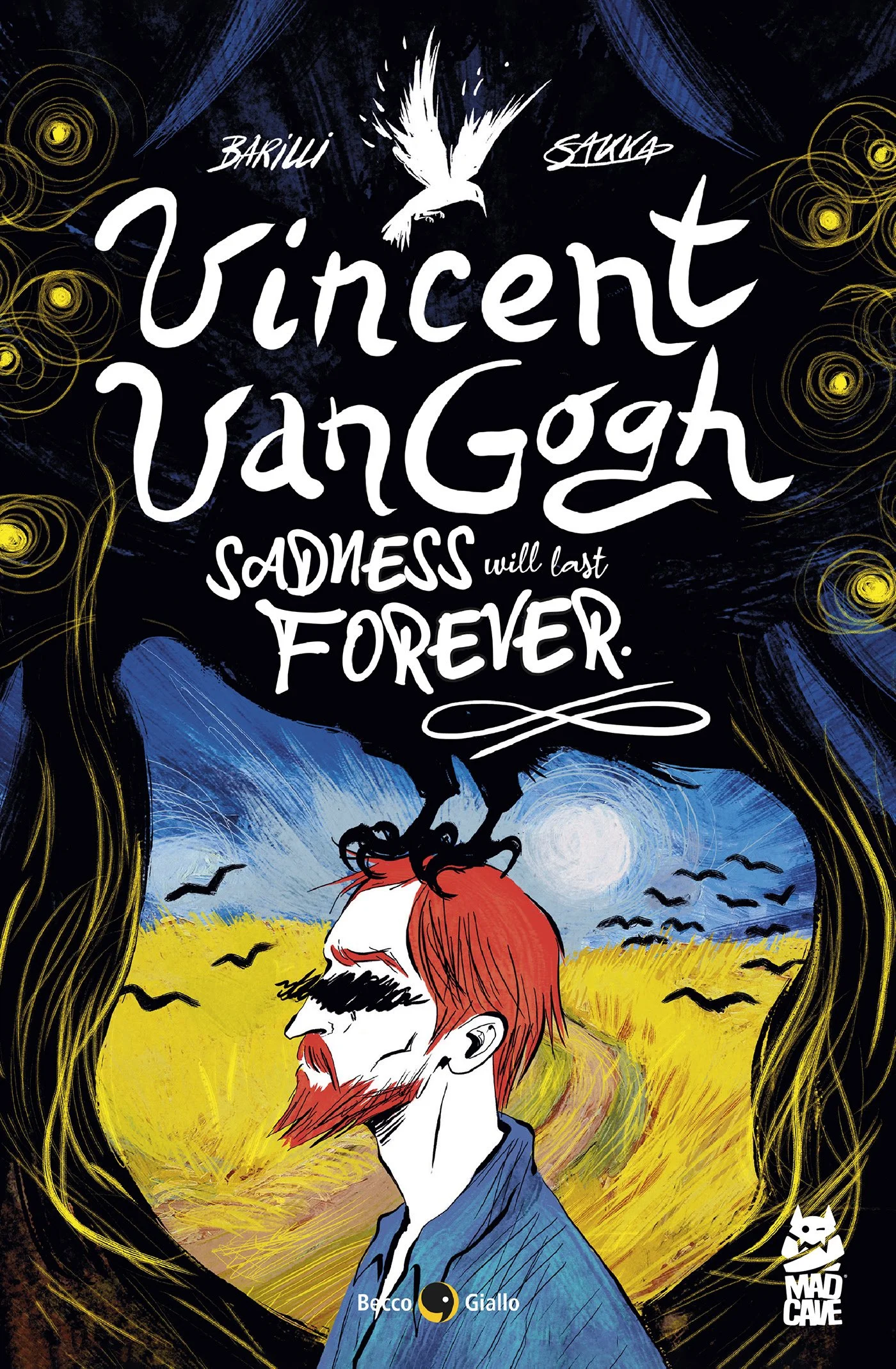
Vincent Van Gogh: Sadness Will Last Forever
Creative Team
writer: FRANCESCO BARILLI
artist: ROBERTA SAKKA
publisher: MAD CAVE STUDIOS
Art, mental illness, self-loathing, and the historic power of letter-writing come together in Vincent Van Gogh: Sadness Will Last Forever, translated for English audiences by Mad Cave, written by Francesco Barilli and with art by Roberta Sakka.
Trigger warning: Suicide, violence, sexual health, mental health, incarceration, self-harm
Taking its name from a line in a letter written by Vincent’s brother Theo after and about the artist’s death, Van Gogh: Sadness Will Last Forever is an unflinching narrative developed by Barilli in part from a careful, studious attention to the writings and letters of Van Gogh and his family, with Sakka’s darkly expressive storytelling filling the page, while interpreting Van Gogh’s portfolio for this mature-audiences biographic work.
Beginning with a morose nod to Van Gogh’s childhood, the story shifts to the adult artist nearing his demise, recounting between himself and the ‘voice inside his head’ as an immediate reminder that this artist struggled with extreme depressive issues and acts of self-harm, setting the stage for what is a critical self-review into the end of his life.
Barilli’s narrative treads this sensitive narrative balance carefully.
By revealing each phase of Van Gogh’s career through a lens of unkind self-critique, he pulls back the curtain and to show the very real relationships with the people Van Gogh cared most about, and how his work reflected his immediate life, valuing his personal world over staged inspiration: Nature, real people in real settings, the objects that he surrounded himself.
With Barilli’s help, we see Van Gogh slip in and out of his own narratives as well. An awkward brother in need to his successful kin Theo, a man who wants to help the downtrodden, while he himself is downtrodden. He’s an excited, if apprehensive, friend looking forward to his fellow artist Gaugain coming to stay. Then, a man devastated to the point of a mental break, bereft of part of an ear. Another breaking point. A man committed to a hospital. Then once again free to paint nature one last time.
He works himself into the cage of his own mind, literally, as Sakka shows us.
In complement to the complex story, Sakka’s brilliant pagework pulls the audience through each chapter. Readers will be moved through pages that breathe with anxiety and emotions, in a scrawling, deeply purposeful style that gives the impression of wildness while carefully building anticipation.
Sakka’s depictions of Van Gogh’s life and artistic style also slowly evolve behind the narrative, giving the impression of that impressionist’s growth of skill, but also lending each chapter its own distinct emotional feeling.
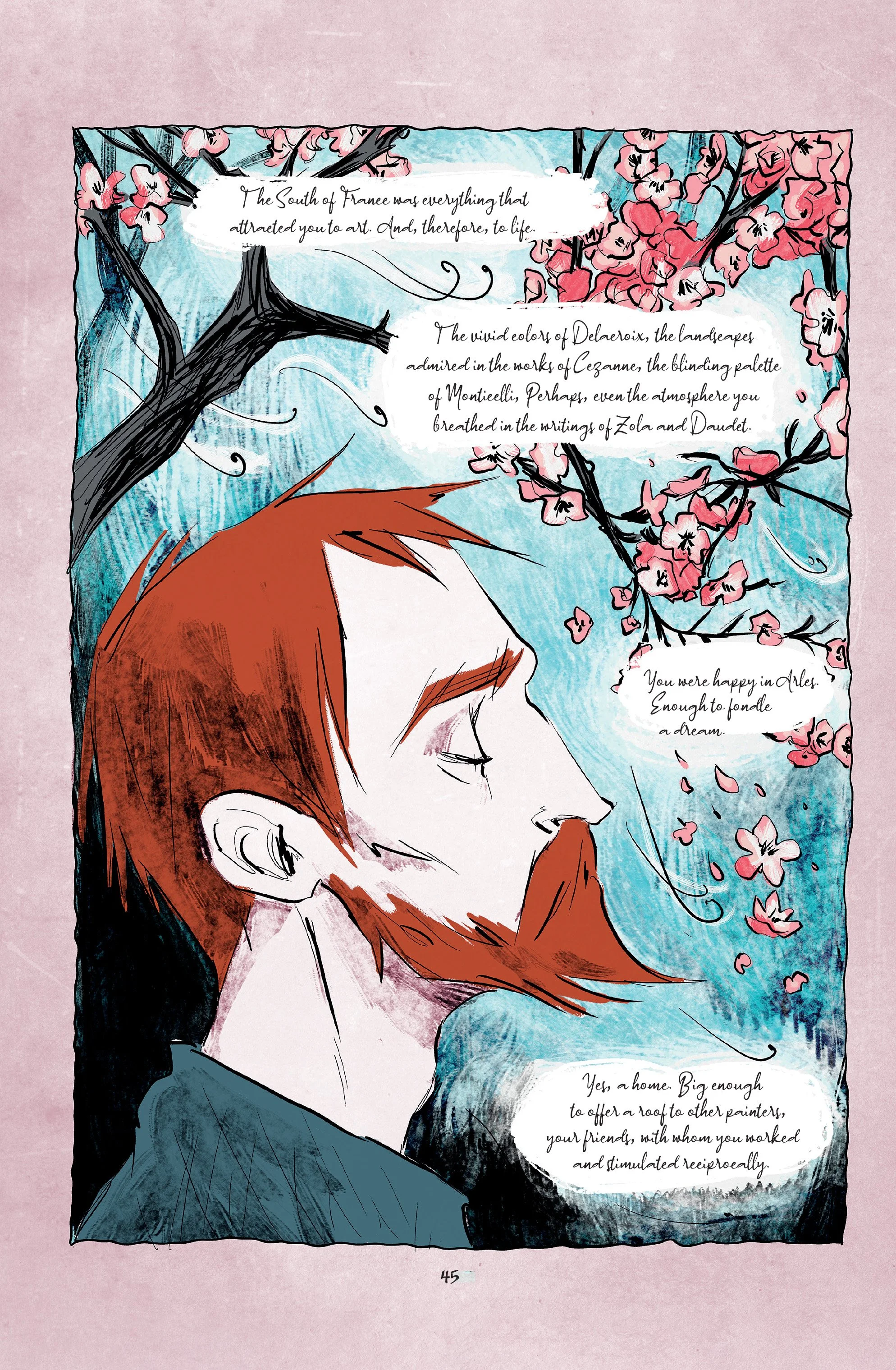
Instead of composing work inside the book that is an exact replication of Van Gogh’s, Sakka reimagines it to show his conflicts and mental state and to punctuate the timeline with artistic milestone references to significant pieces of work.
The first of which is his model and love Clasina “Sien” Maria Hoornik, a seamstress, sometimes prostitute, depicted “Sorrow,” which he considered his point of mastery of drafting the human form.
Where in reality the work itself is a softly drawn piece, Sakka lends the public’s harsh opinions about its subject, using harder and decisive linework with stark coloration.
There is distinct visual development between depictions of “The Potato Eaters” and “The Prisoner’s Round,” showing the growth in Van Gogh’s composition, but then Sakka strategically pulls all this stylistic progress back in showing “Self-Portrait With Bandaged Ear.” Reflecting his regressed mental state, this is a composite-style hewn sketch.
The book does not shy away from the events and realities of Van Gogh’s short career: emotional turmoils, explosive incidents, isolation and moodiness, hospitalizations for mental illness, of course the fight with Gauguin and the subsequent ear episode. But it also in no way embraces, grandizes, romanticizes or judges it.
This is an honest, beautiful service to the harsh life of one of art history’s most famed yet troubled figures, critically executing a biographical tale of heartaches, regrets and sadness without overly reveling in Van Gogh’s very real mental health issues.
Final Verdict: Add to Your TBR
Note: If you or a loved are experiencing thoughts of suicide, suicidal ideation or self-harm, help is available at the National Suicide Helpline for text or talk: https://988lifeline.org/
Further notes:
This critic deeply enjoyed the writer’s notes discussing the movie depictions of Van Gogh’s life and the firm positions taken. Readers, read this one to the last page.