One Path: The White King
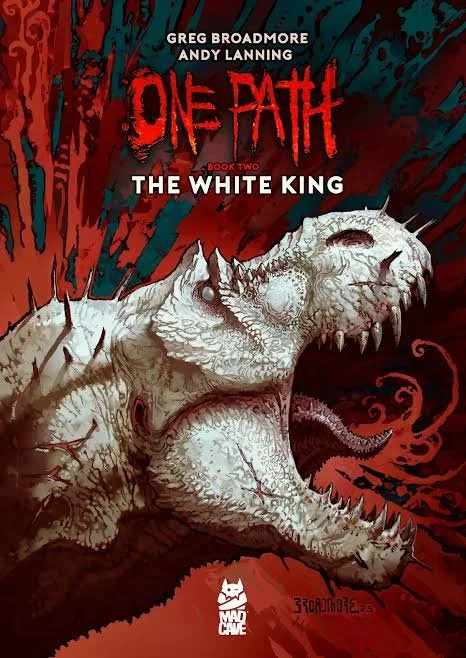
Creative Team
writers: GREG BROADMORE & ANDY LANNING
artist/colorist: GREG BROADMORE
letterer: ROB JONES
publisher: MAD CAVE STUDIOS
A gruesome, gory world, where infants are born from the earth; where amalgams of flesh pass bloody judgment on the infants’ mothers-to-be; where woman and beast contend to vanquish the other. One Path: The White King continues Greg Broadmore’s disturbed epic with the unrelenting gait of an apex predator.
Hunted by Una’s tribe and the White King, One Path journeys to the Towers in search of sustenance for her cursed infant.
From cover to cover, book two’s art speaks for itself. Broadmore’s digital rendering becomes terrifyingly precise at times—like when the reader faces the fleshy eyes of an ‘indescribable thing’ that would impress even Lovecraft. At others, his rendering loosens to depict the intense clashes of hulking reptile bodies, the splatter of a dimetrodon against jagged stones, or the vast landscapes that accompany One Path on her journey.
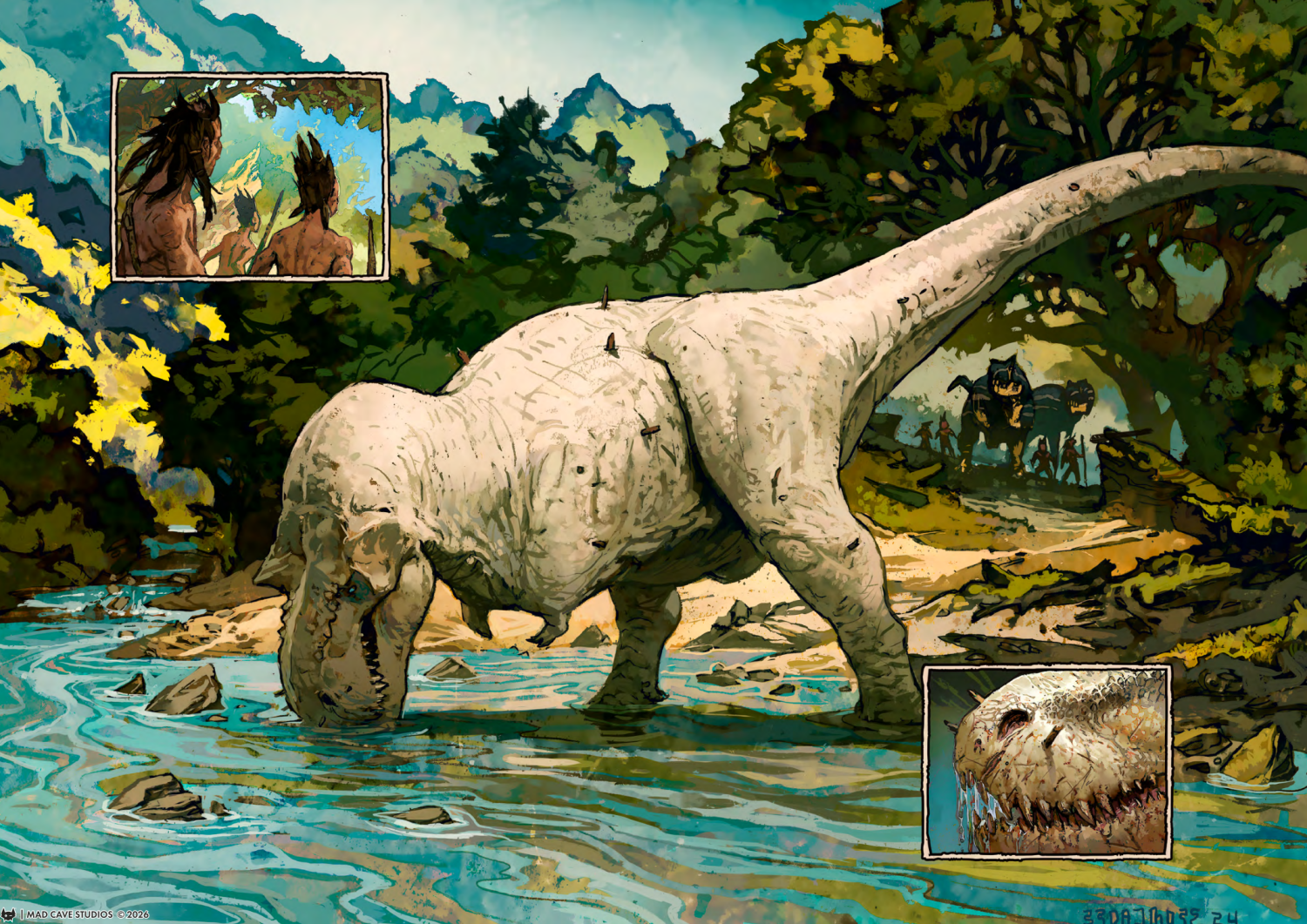
It is difficult not to get lost in each of Broadmore’s panels thanks to their exceptional depth—whether in color, scope, or style. (A favorite mark is how rippling waters are painted.) Nonetheless, clear paneling ensures the eye travels smoothly across the page. The frequent choice of stacked wide panels, for example, is comfortable to read and lends an especially cinematic feel to action and exploration sequences.
One Path’s artwork pays special attention to showcasing its dinosaurs’ many behavioral subtleties: The Runtling’s found family loafs at night much like birds would today. The tribe’s t-rexes cower and urinate in fear of the Albino. The Red Beast charges at its aggressors with a naive gusto that contrasts the Albino’s deliberate sadism.
Broadmore’s creatures answer each to its own instinct. Their animality (neither monstrous nor anthropomorphized) makes them as exciting to read as their human counterparts.
Whereas book one primarily followed One Path, book two further explores the perspectives of the Runtling and Una. The tribeswomen’s psychologies come across as intentionally primitive, as opposed to the seemingly convoluted ‘hidden world’ the book makes scattered allusions to. The meaning of all these—these ceremonies of birthing and bowel-letting—is tantalizingly withheld for future installments.
One Path: The White King is unparalleled in its sheer brutality. An excellent read for the morbidly fascinated, with an engaging story to back up its stellar visuals. With two remaining parts, now is the time to catch up on both books!